

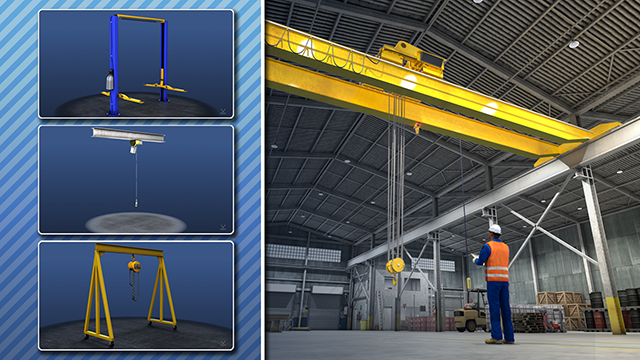
As loads start to tip into the multi-tonne range, or process odd footprints that simply cannot be palletized, overhead cranes and hoists take the limelight. Bridge cranes run along runways that are suspended from building rafters to lay beams, coils, or injection moulds directly on staging areas. Pendant (or radio) controls maintain safe distancing between operator and heavy transport favourite, prideful of their variable-frequency drives that capped millimetre-level finesse at crawl speeds before ramping all the way to full travel velocity. Freestanding Jib Arms Mounted Hoists — these are ideal for assembly lines that are traversing limited footprints but need to rotate heavier sub-assemblies with regularity. These systems free up precious floor space and cut congestion, an often overlooked but important factor in accident prevention, by elevating transport-lanes over ground traffic.
Ergonomics at the Perfect Height
Even today, repetitive bending and overstretching are among the top two triggers of musculoskeletal injuries. Plastic crates from plastics2go tackle that issue by providing the worker with the load rather than forcing the worker to go to the load. Pallets totes or work pieces are elevated to a comfort reach zone thus maintaining neutral spine posture using hydraulic cylinders or screw-drive columns. Programmable Logic that allows operators to slowly raise the deck height as each row of product is picked is helpful in kitting or sequencing cells to help maintain a consistent pick height which in turn speeds up cycle times. Lynx-models rated for several tonnes are found beneath roller conveyors, raising incoming product to the precise supplemental height for reliable transfer. Scissor lifts are easily incorporated into retrofits, as they can be surface-mounted without pits, and can migrate with production layouts changes.
Automated Storage & Retrieval Systems
AS/RS — Automated storage and retrieval systems — take load management into the territory of the algorithm. Shuttles that run down the aisles or crane stacker systems slide through high-density racking sometimes soaring ever higher than reach of a standard forklift. Confirmation using a barcode or RFID at every shelf location develops a real-time location-based inventory record and directly feeds into enterprise planning modules. Dual-cradle designs can perform simultaneous put-away and retrieval, doubling effective cycle rates with no increase in aisle width. The net part is tens of thousands of square feet of reduced footprint, allowing existing buildings to take in new product lines instead of creating a new development from scratch. When these systems are used in applications that require near 100 percent order accuracy, the AS/RS often pays for itself almost immediately as pick errors, shrinkage, and labourvariability see a drastic drop.
Flexible on Demand Transport
AGVs and AMRs overcome a limitation of fixed conveyors: inflexibility of routes. These autonomously navigating platforms, using magnetic tape, QR codes, or perception to identify surrounding environments, delineate optimal routes from point-to-point among workstations and are able to seamlessly adjust as floor layouts, demand patterns, or human traffic flows. They run untethered, so scaling up at peak seasons is a software exercise rather than a capital retrofit. Load-specific top modules—roller decks, lift platforms, or tugger hitches—customize each robot to pallets, carts, or individual totes, depending on the need. Some of the most advanced fleet managers coordinate dozens of vehicles in real time, trading off charging cycles for task priority to avoid queues and congestion. With soaring battery densities, AGVs and AMRs stretch their battery life to cover an entire shift on a single charge, further accelerates ROI.
Final thoughts
The physical machines do the dirty work, but they’re only as strong as their coded capabilities from castors2go at that job; the more coordination a fleet has for this work, the more potential each piece of hardware has, waiting until a software spigot turns on and it does something together from a cabin of CPUs. Work is assigned to pickers based on proximity and load weight, and equipment availability, reducing idle travel and minimizing queuing in modern warehouse management systems.

